Courses
About the university
Danylo Halytsky Lviv National Medical University is one of the oldest and largest academic centers in Ukraine and one of the leading universities with level IV accreditation, the highest level.
| Origins | since 1784 as the Faculty of Medicine of the University of Lviv |
|---|---|
| Faculties and departments | 6 faculties, 78 departments (including 48 clinical departments) |
| Academic staff | 1,211 academics, including 113 professors |
| Clinical facilities | 41 hospitals |
| Library | over 530,000 volumes |
| Dormitories | 8 |
| Address | 52 Pekarska Street, Lviv |
History
The university began as the Faculty of Medicine of the University of Lviv, which opened on November 16, 1784, with the approval of Emperor Joseph II of Austria. Today it is one of the most important medical universities in Ukraine.
Programs for international students
International students can study at the faculties of medicine, dentistry, and pharmacy, as well as in the preparatory course and the postgraduate internship. Permit АГ №582786 of the Ministry of Education and Science, Youth and Sports of Ukraine, dated February 7, 2012, sets the admission quotas for international students.
| Track | Quota |
|---|---|
| First year of study | 250 students |
| Preparatory course | 100 students |
| Postgraduate studies | 150 students |
Scientific schools and staff
The university is home to 22 active and growing scientific schools: obstetrics and gynecology, biochemistry, hygiene, infectious diseases, history of medicine and pharmacy, microbiology, morphology, neurology and neurosurgery, oncology, otorhinolaryngology, ophthalmology, pathological anatomy and pathophysiology, pediatrics, psychiatry, dentistry, internal medicine, pharmacology, physiology, physiotherapy, chemistry and pharmacy, and surgery.
The 78 departments, the Institute of Clinical Pathology, the Central Research Laboratory, and the Industrial Toxicology Laboratory employ 1,211 academics, including:
- 134 Doctors of Sciences and over 620 PhD holders;
- 113 professors, 369 associate professors, 50 senior lecturers, 662 assistant lecturers, and 17 research fellows;
- 23 full members and 7 corresponding members of academies of sciences;
- 12 honored scientists and engineers, 7 honored educators, 19 honored doctors, and 1 honored worker of physical culture and sports;
- 8 laureates of the State Prize of Ukraine in Science and Technology.
Library
The university library holds over 530,000 volumes of textbooks and medical literature and offers modern computer equipment and internet access. It is connected to the city’s other academic libraries.
Cooperation
The university’s researchers work closely with colleagues abroad in various fields of medicine and pharmacy. LNMU has signed and is implementing cooperation agreements on medical education and research with universities including the following:
- Jagiellonian University Medical College
- Medical University of Silesia
- Medical University of Lublin
- Poznan University of Medical Sciences
- Medical University of Warsaw
- Wroclaw Medical University
- Medical University of Gdańsk
- Medical University of Białystok
- Medical University of Sofia (Bulgaria)
The university is a member of international and European university associations and of almost 70 other international organizations, academies, and federations. It is listed in the World Health Organization (WHO) directory and in the directory of Central European universities. LNMU ranks at the top of rankings of Ukrainian universities and medical universities (Scopus 2010: 2nd place among Ukraine’s medical universities and academies).
Campus and facilities
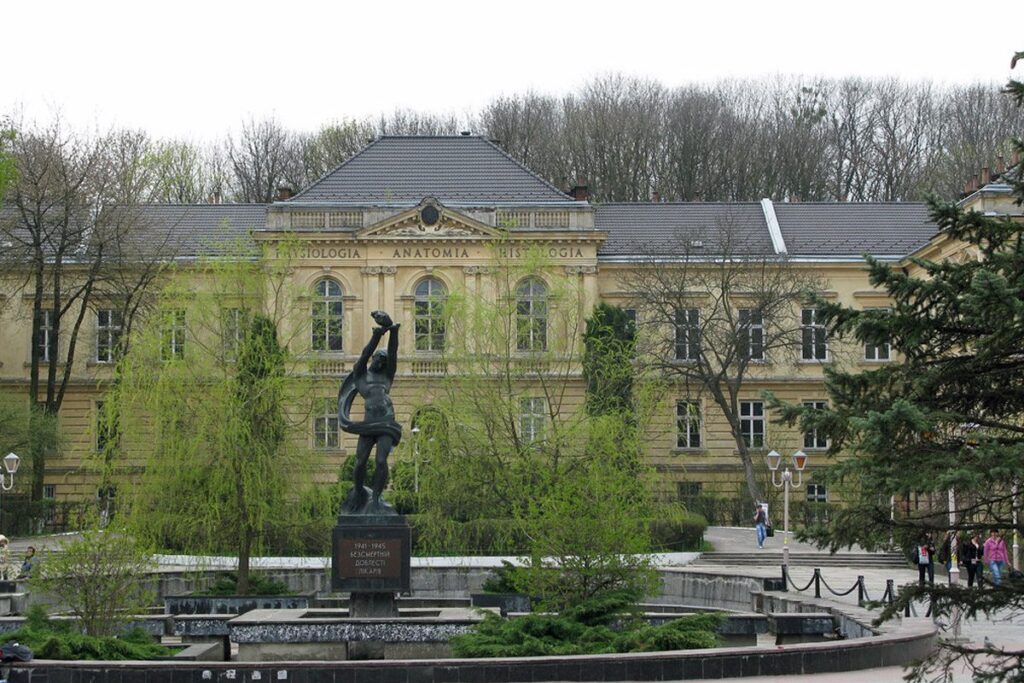
The university’s complex of buildings stands at 52 Pekarska Street, surrounded by a park. The buildings were constructed between 1891 and 1898 to a design by Józef Braunseis for the Faculty of Medicine of the University of Lviv. In front of the entrance to the main building is a square with a fountain, and inside are plaques commemorating Jakub Parnas and Marceli Nencki. The neighboring building houses the Museum of Human Diseases.
The university also owns the former St. Joseph Orphanage at 69 Pekarska Street. During the Second Polish Republic, it housed the Infectious Diseases Hospital, and today, in addition to teaching facilities, it is home to the Anatomical Museum. The building is surrounded by a 5.4-hectare park with a botanical garden (1.5 hectares).
The university comprises:
- 6 faculties and a medical college;
- 78 departments, including 48 clinical departments, and 14 teaching buildings;
- 41 clinical facilities and a university dental clinic that handles more than 2,000 visits per shift;
- a teaching pharmacy and a botanical garden;
- the Central Research Laboratory, the Industrial Toxicology Laboratory, the Institute of Clinical Pathology, and an anticancer drug research center;
- a library, 8 dormitories, a sanatorium, cafés, and student cafeterias;
- the “Medyk” sports and health camp.
Student life
The university has 40 amateur ensembles, clubs, and studios, as well as 23 sports and recreation clubs. Three ensembles hold the title of folk ensemble: the “Horytsvit” folk dance ensemble, the “Muses of Hippocrates” folk choir, and the “Medicus” folk ensemble.