
Courses
About the university
Ivano-Frankivsk National Medical University is a leading medical university and one of the oldest in Ukraine, with level IV accreditation, the highest level. It is recognized by the World Health Organization (WHO), the Medical Council of India (MCI), and the World Directory of Medical Schools.
| Founded | October 6, 1945 |
|---|---|
| Students | nearly 4,000 from around the world |
| Academics | 6 programs across 5 faculties |
| Clinical facilities | 12 hospitals and clinics, 48 departments |
| Study system | Bologna system, ECTS credits |
| Libraries | 4, over 800,000 volumes |
History of the university
- October 6, 1945: The Stanislav State Medical Institute (Ukr. Станіславський державний медичний інститут) is founded.
- 1962: After the city is renamed, the institution becomes the Ivano-Frankivsk State Medical Institute (Ukr. Івано-Франківський державний медичний інститут).
- 1992: The Ivano-Frankivsk State Medical Academy (Ukr. Івано-Франківська державна медична академія) is established on the basis of the institute.
- November 27, 2008: The university receives its current name.
The university today
The university has a total of 12 hospitals and clinics and 48 departments. Nearly 4,000 students from around the world study medicine here, including students from Poland, Australia, Africa, the USA, India, and other parts of Asia.
It’s an ideal place for students looking for a high-quality education at a reasonable price. A big advantage is the Bologna system of study and the European Credit Transfer System (ECTS). The curriculum is very similar to the Polish one, so transferring to another university, if needed, is not a problem.
Libraries
The university has 4 libraries. The regional medical library in the city center holds over 700,000 volumes, including a rich collection of domestic and foreign journals, dissertation abstracts, and dissertations, as well as a wealth of specialist and bibliographic literature. Around 20,000 new books are added every year, and the library subscribes to 400 domestic and foreign journals.
The other three libraries are on campus: a short-term lending library, a long-term lending library, and a computer library with online literature. Their collections include over 800,000 books, journals, and dissertations from different parts of the world, in Ukrainian, English, Russian, French, and German. The electronic reading room has access to the university database and the internet, and the university provides students with all the literature they need for their studies. The academic library supports the university’s teaching, research, information, and cultural work.
Free textbooks for the whole year
On their first visit to the library, every student receives a free set of books for the whole year. It’s worth going as early as possible, because that’s when you get the better, newer copies. It’s also worth checking the Moodle platform, which has good books in PDF, including atlases.
Campus and classes
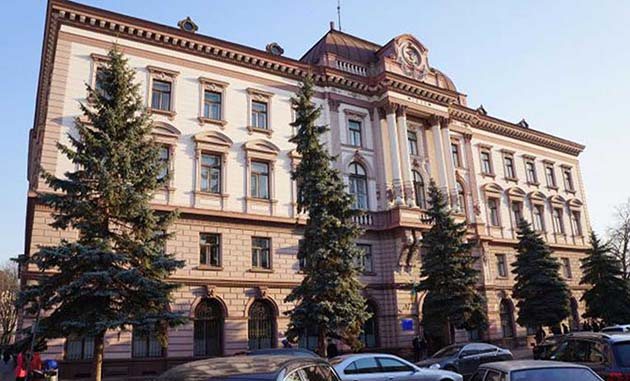
Classes take place in many teaching buildings located close to one another, right in the city center. There is a 30-minute break after every class, so you have plenty of time to yourself. Only the hospitals and the sports complex are a little farther away, but getting there is no problem.
Cooperation
The university works with many associations, such as the Eurasian Universities Union EURAS, the British Medical Association, the International Federation of Medical Students’ Associations, and the Ukrainian Association of Graduates of the French Educational Programs. It also works with many universities and institutions around the world, many of them Polish:
- Lincoln University College (Kuala Lumpur, Malaysia)
- Yanka Kupala State University of Grodno (Grodno, Belarus)
- Foundation “Rapid Medical” (Santander, Spain)
- Charity Organization “International Center for UNESCO Program Implementation”
- St. Petersburg Scientific Research Institute of Ear, Throat, Nose and Speech (St. Petersburg, Russian Federation)
- Medical University of Lublin (Lublin, Poland)
- Association of Family Medicine in Maramureș (Romania)
- University of Opole (Opole, Poland)
- University of Žilina (Žilina, Slovakia)
- Lithuanian University of Health Sciences (Kaunas, Lithuania)
- Opole University of Technology (Opole, Poland)
- East Tallinn Central Hospital (Tallinn, Estonia)
- Medical School of the University of Leeds (Leeds, Great Britain)
- University of Tartu (Tartu, Estonia)
- State Higher Vocational School in Chełm (Chełm, Poland)
- Medical University of Silesia (Katowice, Poland)
- The University of Humanities and Economics in Lodz (Lodz, Poland)
- Specialist Hospital in Brzozów, Rev. B. Markiewicz Subcarpathian Oncology Center (Brzozów, Poland)
- Hangzhou Sherai International Consulting Ltd. Co.
- Institute of International Academic and Scientific Cooperation
- Polish Institute EBM (Krakow, Poland)
- Organization “Polkraine” (Warsaw, Poland)
- Department of Psychology of the University of Bologna (Cesena, Italy)
- University of L’Aquila (L’Aquila, Italy)
- Nicolae Testemițanu State University of Medicine and Pharmacy (Chișinău, Moldova)
- European University (Tbilisi, Georgia)
- International Center for Treatment, Therapy and Rehabilitation of Addictions and Civilizational Diseases “Mental Relax House” (Turawa, Poland)
- International Medical Education Organization BRIMEA “Belt and Road”
- Ukrainian Medical Students’ Association “UMSA” (Odesa, Ukraine)
- University of Valladolid (Valladolid, Spain)
- University of Rzeszów (Rzeszów, Poland)
- Medical University of Warsaw (Warsaw, Poland)
- University of Debrecen (Debrecen, Hungary)
The city of Ivano-Frankivsk
Andrzej Potocki founded the city in 1662 and named it Stanisławów after his father, Stanisław. It began as a fortress against the Crimean Tatars and a stronghold of the Polish nobility in Galicia. At the end of the 18th century, the city was taken over by the Habsburg monarchy, which held it until the beginning of World War I. In 1918, it became the capital of the short-lived West Ukrainian People’s Republic. In 1962, on its 300th anniversary and by then part of the USSR, it was renamed Ivano-Frankivsk. The name honors Ivan Franko, a great Ukrainian writer and social activist who did much to preserve the Ukrainian language and culture.
The city was a major center of trade and crafts that attracted people of many nationalities. The largest communities were Jewish, Armenian, and Polish, and their presence can be seen in the architecture: buildings in a variety of styles give the city its unique charm. During the heavy fighting in the early 20th century, some historic buildings were destroyed and later rebuilt in a new style, but Ivano-Frankivsk still stands out for its elegance and grace.
“Little Lviv”
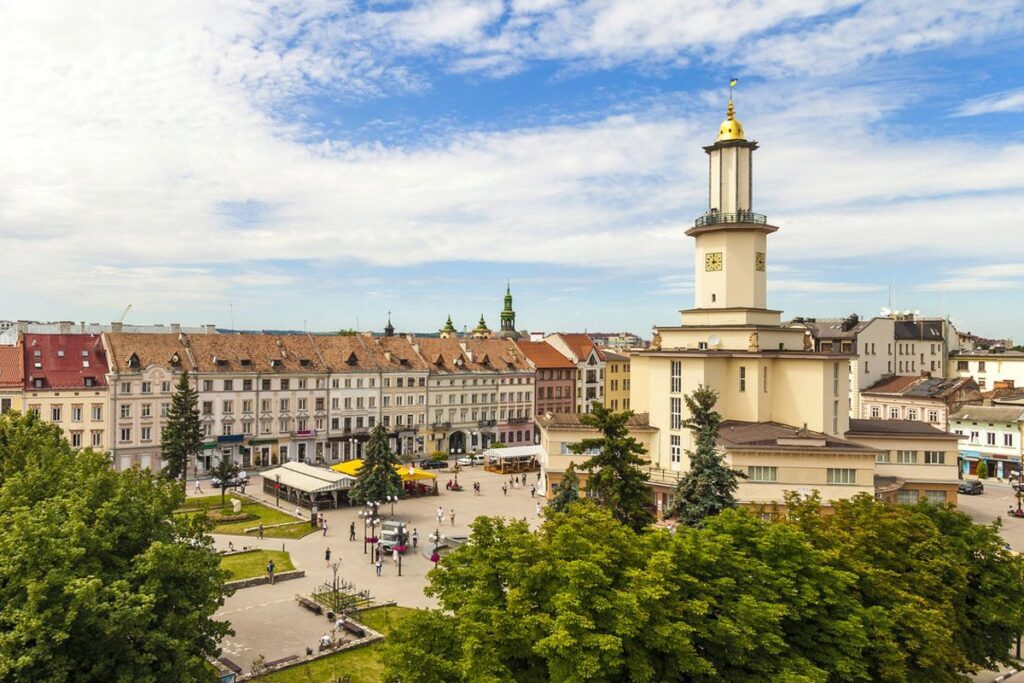
As in many European cities, the heart of the city is the Market Square, lined with charming townhouses. Its style resembles that of Lviv, which is why Ivano-Frankivsk is often called “Little Lviv.”
In the middle of the Market Square stands the town hall, the only one in Ukraine built in the modernist style. The first town hall was built here in the 17th century, was later rebuilt several times, and has looked the way it does today since 1932. Today it houses exhibits from the local history museum, including collections of old furniture, weapons, and books, as well as a tourist information center. In front of the town hall stands one of the city’s most famous fountains, the Egg Fountain.
The most valuable religious monuments are clustered around the Market Square. A special place among them belongs to the late Baroque former Armenian church from the 18th century: in Soviet times it housed the Museum of Religion and Atheism, and today it is the active Orthodox Cathedral of the Intercession (Pokrova). Nearby stands the Church of the Blessed Virgin Mary, the oldest building in the city, built in the 17th century as the mausoleum of the Potocki family. Today it is an art museum with Galician icons, works by classical Western painters, and masterpieces by Polish, Austrian, German, and Italian painters. Next to it is the Baroque Greek Catholic Cathedral of the Resurrection, rebuilt from a former Jesuit church.